


Table of Contents
- What Makes a Plus Size Bra Supportive?
- How to Measure Bra Size at Home (Step by Step)
- Signs Your Bra Doesn't Fit Correctly
- Best Features for Plus Size Bra Support
- Troubleshooting Fit for Different Body Shapes
- How to Find Supportive Plus Size Bras for All-Day Wear
- Frequently Asked Questions
Last Updated: September 16, 2026
What Makes a Plus Size Bra Supportive?
Support comes down to three structural elements: a firm band that anchors to the ribcage, underwire or structured side panels that distribute weight, and straps wide enough to avoid digging in. Cup size alone tells you little about whether a bra will hold.
The Engineering Behind Real Support
Three components determine how well a bra supports a fuller bust:
- Band tension: A snug band sits level around the ribcage and resists riding up. If you can pull the band more than two fingers away from your back, it is too loose to carry weight.
- Cup construction: Seamed or molded cups with a full underwire hold breast tissue forward and up. Unstructured cups let tissue migrate toward the underarms.
- Weight distribution: Reinforced straps and side support panels spread pressure across the shoulders and ribcage instead of concentrating it in one spot.
Full Figure vs. Full Coverage: What's the Difference?
These terms describe different things. Full figure refers to the size range a bra is designed for, typically DD+ cups and bands above 38. Full coverage describes how much of the breast the cup covers, usually the entire bust with no spillover. A bra can be one without the other, so check both: you want a bra sized for your proportions and cut to cover them.

How to Measure Bra Size at Home (Step by Step)
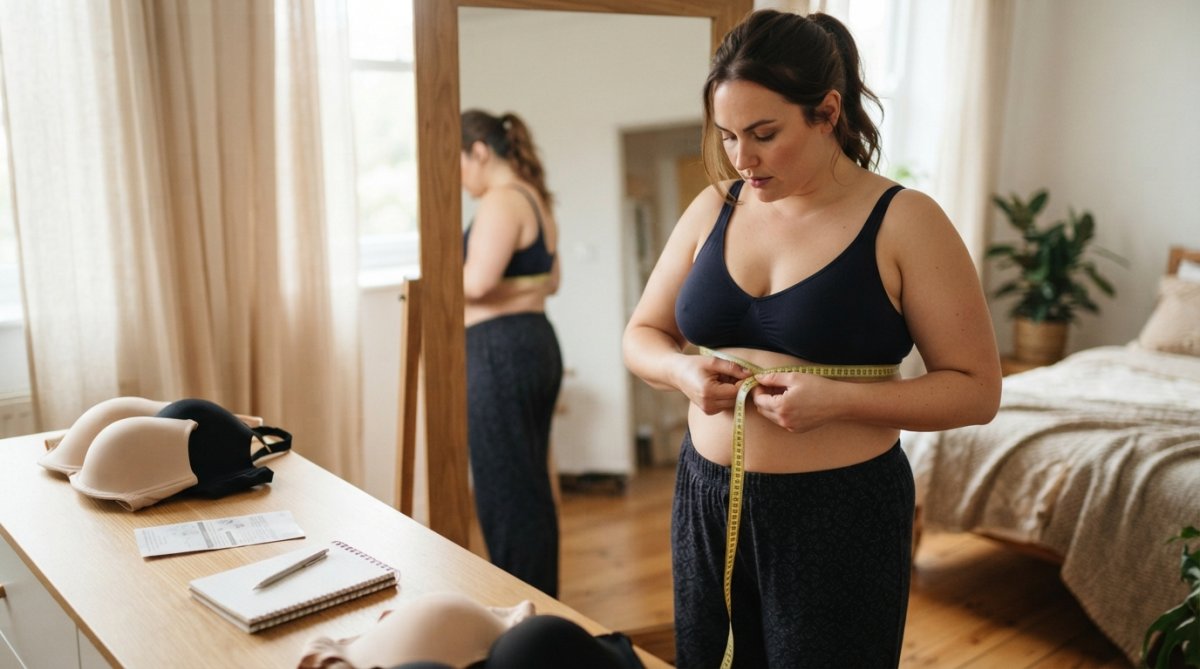
Measuring at home takes about five minutes and a soft tape measure. Wear an unlined bra or none, stand in front of a mirror, and keep the tape level.
Signs Your Bra Doesn't Fit Correctly
Five warning signs mean it is time to remeasure:
- The band rides up in back. The band is too loose and the straps are doing work they were never designed for.
- Straps leave deep grooves in your shoulders. The band is not carrying its share of the weight.
- The gore floats away from your chest. The cups are too small or too shallow.
- You spill over the top or sides. Cup volume is insufficient, even if the band feels right.
- You adjust constantly. A supportive bra stays put through a full day; if you are tugging by lunch, the fit is wrong.
The fix is rarely "buy a bigger size", more often it is a band-size adjustment or a different cup construction.
Best Features for Plus Size Bra Support
The features that matter most for DD+ busts are reinforced straps, a wide band, side support panels, and a hook-and-eye closure with at least three rows. These decide whether a bra holds for eight hours or gives up by noon.
Band Width and Hook Count
A supportive band is wider than a standard one, usually two to three inches of elastic at the back, and closes with at least three rows of hooks. The extra rows let you tighten the band as the elastic relaxes, extending the bra's life. A single-row hook closure on a 40G is a warning sign: with no adjustment range, the band will ride up within weeks.
Reinforced Straps
Straps on a supportive plus size bra should be at least three-quarters of an inch wide, often closer to an inch, and padded where they cross the shoulder. Wider straps spread pressure across more surface area, preventing the deep grooves that appear when a band is not carrying its share of the weight.
Side Support Panels
Side panels, sometimes called side slings, pull breast tissue forward and center it. For wide-set or shallow-rooted shapes, this is often the single feature that makes a bra feel supportive rather than restrictive. Without them, tissue migrates toward the underarms and the cup looks empty at the front even when the size is correct.
Cup Construction: Seamed vs. Molded
Seamed cups, built from two or more stitched fabric pieces, follow the natural curve of a fuller bust and hold shape better over time. Molded cups are smoother under clothing but rely on foam that compresses with wear.
Underwire and Wire Channel
A supportive underwire sits in a cushioned channel that keeps it from poking through fabric or digging into the ribcage. The wire should be firm enough to hold its curve but flexible enough to move with you.
Fabric and Breathability
Mesh panels, moisture-wicking linings, and cotton-lined cups help a supportive bra stay comfortable all day. Breathability matters more in larger cup sizes because more skin contacts fabric.
Wireless Support: What It Takes to Work
Wireless bras can support DD+ busts, but only when they compensate with structured side panels, a wide band, and wide straps. A wireless bra will not match the firmness of a full underwire, but for long days, travel, or post-surgical comfort, that softer hold is often worth it.
Minimizer vs. Full Coverage: Choosing Your Style
A minimizer uses wide straps, a wide band, and full underwire to hold DD through I cups while smoothing the profile under work blouses. For everyday support without the minimizing effect, full coverage keeps your natural shape intact.

Troubleshooting Fit for Different Body Shapes
Standard sizing charts assume a uniform torso, but the same cup size fits very differently depending on where your breast tissue sits.
- Shallow breasts with a wide root: You may need a larger band and a cup with wider wires. If the wire sits on breast tissue instead of around it, size up in the cup.
- Full on bottom: Look for cups with more depth at the base. Balconette and full-coverage cuts often work better than plunge styles.
- Full on top: Plunge and demi cuts can work if the cup has enough depth at the top edge. If you spill over, go up a cup size.
- Close-set breasts: A low gore prevents the center piece from digging in. High-gores will press into tissue.
- Wide-set breasts: Side support panels pull tissue forward and center it, which improves both fit and silhouette.
How to Find Supportive Plus Size Bras for All-Day Wear
All-day support is a different problem from fitting-room support. A bra that feels fine for ten minutes can be unbearable by hour six, and the reasons are almost always structural: a stretched band, a creeping strap, a shifted wire, or fabric that traps heat.
Start With the Band, Not the Cup
The band is the anchor: roughly 80% of the bust weight transfers to it, and the straps only refine the fit. For all-day wear, the band must be snug enough to stay level in back without leaving red marks. Fasten a new bra on the loosest hook; as the elastic relaxes over months, move to the tighter hooks, which is why three rows of hooks matter more for all-day wear than for a special-occasion bra.
Match the Construction to the Length of Your Day
- Full underwire with a firm band: Best for long workdays, standing roles, and any day that involves a lot of movement. The wire creates a rigid frame that keeps the bust from bouncing and the band from shifting.
- Wireless with structured side panels: Better for travel, desk days, and recovery periods. The hold is softer, but a well-built wireless bra with wide side panels can still keep tissue centered for hours.
- Minimizer with wide straps and band: Useful when you need a smoother profile under a button-down or fitted top, but check that the minimizing effect does not come at the cost of cup depth.
The Fit Checks That Predict All-Day Comfort
Run these before you commit to wearing a bra for a full day:

- Band level in back. If the band rides up, the straps are doing work they were not designed for, and by afternoon your shoulders will feel it.
- Gore flat against the sternum. A floating gore means the cups are too small or too shallow, and the wire will press into the ribcage as the day goes on.
- No spillover at the top or sides. Spillage is a sign that cup volume is insufficient, even if the band feels right.
- Straps stay put without constant adjustment. If you are tugging at the straps by lunch, the band-to-cup ratio is wrong.
- Wire sits around, not on, breast tissue. A wire that sits on tissue will become painful within a few hours.
Fabric and Heat Management
Breathability matters more in larger cup sizes because more skin contacts fabric. Mesh panels, moisture-wicking linings, and cotton-lined cups help. If you run warm, prioritize mesh and unlined seamed cups over heavily molded ones.
Care That Keeps Support Intact
A supportive bra is an investment, and how you wash it determines how long it stays supportive. Elasticity goes first, and heat kills it.
- Hand wash in cold water, or use a mesh laundry bag on a delicate cycle.
- Never put bras in the dryer. Heat breaks down spandex and elastic.
- Rotate between at least three bras so each one recovers its shape between wears.
- Air dry flat or hanging by the band, never by the straps.
- Fasten the hooks before washing to keep them from snagging other items.
Matching Bras to Necklines and Outfits
- V-neck tops: Plunge or demi cups with a low gore.
- Button-downs: Minimizer styles that reduce projection so the placket lies flat.
- Scoop necks: Full-coverage cups that stay hidden under the neckline.
- Backless or low-back: Convertible straps, though support drops without a full band.
- Sheer tops: Lace-detailed pieces with underwire structure that look intentional under sheer fabric.
The Payoff Beyond Comfort
A bra that stays put and holds shape removes a background layer of discomfort and self-consciousness, changing how you carry yourself through the day. Posture improves when you are not bracing against a digging band or sliding straps.
| Problem | Likely Cause | Fix |
|---|---|---|
| Band rides up | Band too loose | Size down in band, up in cup |
| Straps dig in | Band not carrying weight | Tighten band, check band size |
| Spillage at top | Cup too small | Go up one cup size |
| Wire pokes ribs | Cup too shallow | Try a deeper cup or different cut |
| Constant adjusting | Wrong band-to-cup ratio | Remeasure using the steps above |
Frequently Asked Questions
How should a supportive plus size bra fit?
The band should sit snug and level around your ribcage, providing 80% of the support, while the cups contain all breast tissue without gaps or spillage. The center gore should lie flat against your sternum. Straps should stay put without digging in, and you should be able to fit two fingers under the band. If the band rides up in back or the gore floats, the bra isn't supporting you properly.
What features make a plus size bra truly supportive?
Look for a wide, structured band that distributes weight across your ribcage, reinforced side panels to prevent bulging, and wide straps that don't cut into shoulders. For DD+ cups, underwire provides firm lift, while wireless styles need structured side panels for anti-sag support. A hook-and-eye closure with at least three columns allows adjustment as the band relaxes over time. Breathable fabrics like mesh keep you cool without sacrificing hold.
How do I measure my bra size at home?
Measure your underbust snugly with a soft tape for your band size (add 4 inches if even, 5 if odd, then adjust to nearest even). Measure your bust at the fullest point without a bra. Subtract band from bust: 1 inch = A, 2 = B, 3 = C, and so on. Always try bras in your calculated size.
Are underwire bras necessary for plus size support?
Underwire provides the firmest lift and separation, especially for DD+ cups, but it's not the only option. Wireless bras with structured side panels and wide bands can offer medium support without wire discomfort. If you prefer wireless, look for styles that go up to your cup size and have reinforced side seams. A well-made wireless bra can work for daily wear, while underwire remains best for maximum shaping under fitted clothing.