


Table of Contents
- Step 1: Check the Care Label and Sort Your Lace Lingerie
- Step 2: Choose the Best Detergent for Delicate Lingerie
- Step 3: Hand Wash Lace Lingerie Safely
- Step 4: Using a Lingerie Laundry Bag for Washing Machine Cycles
- Step 5: How to Dry Lace Lingerie Without Damage
- Common Mistakes That Ruin Lace Lingerie
- Frequently Asked Questions
Last Updated: September 19, 2026
Step 1: Check the Care Label and Sort Your Lace Lingerie
Learning how to wash delicate lace lingerie starts with one habit: read the care label before the garment ever touches water. The label tells you whether the maker allows machine washing, which temperature to use, and whether the lace can handle any agitation at all.

Sorting comes next. Lace comes in two broad types, and they behave differently in the wash:
- Stretch lace (nylon and spandex blends) flexes and recovers well, so it handles gentle handling
- Rigid lace (cotton or polyester) has no stretch and snags easily on hooks, zippers, and straps
Keep dark lace away from light lace. Dye from a new black or deep purple piece can bleed onto a pale one in cool water.
Check every garment for loose threads and bent underwires before washing. A single exposed wire can tear through an entire load of lace.
Step 2: Choose the Best Detergent for Delicate Lingerie
The best detergent for delicate lingerie is a pH-neutral, enzyme-free liquid labeled for delicates or fine fabrics. That recommendation is easy to repeat, but the reason behind it is what actually protects your lace, and the reason changes depending on what your lace is made of.
Why detergent chemistry matters for lace
Lace is rarely one fiber. A single piece can combine nylon, spandex (elastane), cotton, polyester, and silk, each with a different tolerance for chemicals:
- Protein-based fibers (silk, wool blends) are dissolved by protease enzymes, the same enzymes added to regular detergent to break down food and body-oil stains. Over repeated washes, protease literally digests the fiber surface, leaving silk lace dull and brittle.
- Cellulose fibers (cotton, rayon) are attacked by cellulase enzymes, which is why enzyme detergent gradually thins cotton lace and opens holes at stress points.
- Spandex and nylon are damaged less by enzymes and more by heat, chlorine bleach, and optical brighteners, which break the polymer chains that give the fiber its stretch and recovery.
That is why "delicate" detergent is not marketing, it is a formula stripped of the enzymes and brighteners that make regular detergent effective on cotton sheets but destructive on lace.
What to look for on the label
- "Free of dyes and perfumes" or "delicate", fragrance oils and dyes can stain pale lace and irritate skin
- No bleach, no enzymes, no optical brighteners, all three weaken fibers over time
- Liquid, not powder, powders can leave grit trapped in lace holes and may not fully dissolve in cool water
- pH-neutral, alkaline formulas (most regular detergents) swell and weaken silk and wool
Products that fit the brief
A few drops of mild, fragrance-free baby shampoo also works in a pinch, it is pH-balanced and free of the enzymes that damage protein fibers. Avoid castile soap for silk; its alkalinity is too high.
How much to use
Use less than you think you need. One teaspoon in a bowl of cool water is plenty for a few pieces. Excess detergent leaves residue in lace holes that traps dirt and dulls the fabric, and it takes more rinsing to remove, which means more handling and more wear on the fibers.
Skip fabric softener entirely. It coats fibers with a waxy film that kills the stretch in elastic and dulls lace. The same goes for dryer sheets, they leave the same residue and add heat damage on top.
Step 3: Hand Wash Lace Lingerie Safely
Hand washing is the safest method for any lace garment, and it takes about five minutes. Fill a clean bowl or sink with cool water, add a teaspoon of gentle detergent, and swirl it in with your hand.
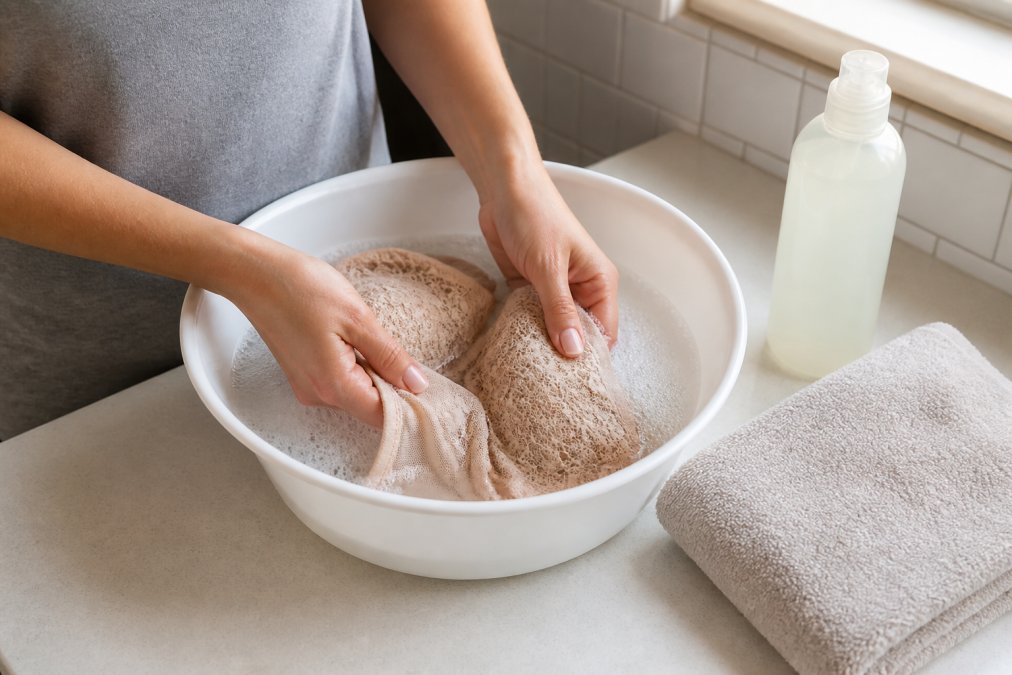
Then follow these steps:
- Submerge the lingerie and let it soak for 10 to 15 minutes
- Gently squeeze suds through the fabric with your fingers
- Never rub, wring, or scrub lace against itself
- Rinse under cool running water until no suds remain
- Press water out against the side of the bowl
Water temperature matters more than most people realize. Hot water breaks down the elastic fibers that give lace its stretch. Cool or lukewarm water keeps them intact.
Step 4: Using a Lingerie Laundry Bag for Washing Machine Cycles
A lingerie laundry bag for washing machine cycles turns a risky wash into a safe one. The mesh bag keeps lace from twisting around other garments and protects it from the drum's direct friction.
Machine washing only works when three conditions line up:
- The care label allows it
- The bag is a fine-mesh type with a zipper closure
- The cycle is set to delicate or hand-wash with cold water
Put one or two pieces per bag, no more. Overstuffing defeats the purpose. Fasten the zipper and tuck the pull inside so it can't catch on lace. Wash lace alone or with other delicates, never with denim, towels, or anything with zippers and hooks.
Take the bag out the moment the cycle ends.
Step 5: How to Dry Lace Lingerie Without Damage
The dryer is the single fastest way to ruin lace. Heat breaks down spandex and nylon, and tumbling stretches straps and bands out of shape. Always air dry.
Here's how to dry lace lingerie the right way:
- Press the garment between two clean towels to remove excess water
- Lay it flat on a dry towel, reshaping cups and straps as it dries
- Keep it out of direct sunlight, which fades dye and weakens fibers
- Let it dry completely before storing
Common Mistakes That Ruin Lace Lingerie
Most lace damage comes from a handful of repeated habits, not one dramatic accident. Fix these and your lace will outlast the rest of your drawer.
- Hot water, breaks down elastic and fades color
- Regular detergent, enzymes eat away at delicate fibers
- The dryer, heat and tumbling destroy shape and stretch
- Wringing, twists and tears lace threads
- Fabric softener, coats fibers and kills stretch
- Overloading the wash bag, friction between pieces causes snags
- Storing damp lingerie, even slightly damp lace grows mildew, and the smell never fully leaves
The mistakes that are specific to your body type
Most guides stop at the list above. But the way lace wears out is not the same for every body, and the fixes that work for one shape can make things worse for another.
Posture and daily movement
How you sit and move during the day determines how fast your lace stretches out, and it also tells you where to look for wear when you wash:
- Sitting for long stretches pushes the back band up and the front band down. If you notice the back band rolling, the band is likely too loose, not too tight.
- Crossing your legs twists the panty gusset and pulls on one side seam more than the other. Check that seam for stretched lace before washing.
- Reaching overhead (shelves, workouts, kids) pulls the band and straps. If your straps have stretched, it is usually from this motion, not from the wash.
DIY fixes that buy you time
These are temporary, they do not repair damaged lace, but they extend the life of a piece between washes or until you replace it:
- Fashion tape on a rolling waistband holds it in place for an evening without altering the garment.
- A safety pin through the inside of a stretched band can take up slack temporarily; remove it before washing so it does not snag lace.
- A tiny dot of clear nail polish on a fraying lace edge stops the run from spreading. Let it dry fully before wearing.
- A spare bra strap clipped across the back of a slipping band adds grip without sewing.
Match the method to the fabric
Fabric care also shifts by material. Stretch nylon lace bounces back from gentle handling, while delicate cotton lace needs extra care and dries more slowly. Silk lace should never touch enzyme detergent or hot water. Match your method to the fabric, and check each piece by hand before it goes in the water.
Frequently Asked Questions
Can you put lace lingerie in the washing machine?
Yes, but only with precautions. Set the machine to a delicate cycle with cold water and place the lingerie inside a lingerie laundry bag for washing machine use. This prevents stretching and snags. Avoid the dryer entirely; instead, lay the piece flat to dry. Hand washing is still the safest method, especially for underwire or heavily embellished lace.
What is the best detergent for delicate lace?
Use a mild, pH-neutral detergent labeled for delicates or lingerie. Avoid bleach, fabric softener, and enzymes, which break down lace fibers. A small amount of gentle detergent in cool water is enough. If you hand wash, rinse thoroughly. For machine washing, choose a formula that rinses clean and doesn't leave residue that can stiffen lace.
How do you dry lace lingerie without ruining it?
Never wring or twist lace. Gently press it between two clean towels to remove excess water, then lay it flat on a drying rack away from direct sunlight or heat. Hanging can stretch the lace and distort the shape. If the piece has underwire, reshape the cups before drying. This method preserves elasticity and prevents misshaping.
How often should you wash lace lingerie?
Wash after every two to three wears, or after each wear if you sweat heavily. Lace is delicate, so overwashing can wear it out, but letting oils and sweat sit can weaken fibers. For special-occasion pieces worn briefly, a gentle hand wash every few wears is fine. Always spot-clean stains promptly to avoid setting them.
Lace lingers longest when you treat it like the delicate piece it is. TLovePlusSize builds lace-detailed sets like The Lace Set and The Goddess Lace Set to hold their shape through proper care, with underwire support and mesh comfort that lasts. Explore the collection and find lace worth taking care of.