


Table of Contents
- What Makes Lace Lingerie Comfortable (and What Doesn't)
- The Best Lace Underwear for Sensitive Skin
- Comfortable Lingerie for Plus Size: Fit and Support That Works
- Structured vs. Unstructured Lace: Which Support Level Is Right for You?
- How to Wash Delicate Lace Lingerie So It Lasts
- Sustainability and Fabric Sourcing: What to Know About Your Lace
- Longevity Testing: How to Tell If Lace Will Hold Up
- Frequently Asked Questions
Last Updated: September 10, 2026
What Makes Lace Lingerie Comfortable (and What Doesn't)
Finding lace lingerie that is actually comfortable comes down to two things: what the lace is made of and how the garment is built. Most discomfort traces back to scratchy fiber blends and exposed seams, not to lace itself.
At TLovePlusSize, we hear the same story: someone buys a lace set, loves how it looks, then can't wear it past lunch. That's a construction problem, not a lace problem.

Comfortable lace starts with soft-touch fibers and stretch finishes that move with you. Textile Exchange's materials guidance notes that fiber blend choices directly affect how a fabric feels against skin and how long it holds its shape.
Fabric Composition: The Difference Between Soft-Touch and Scratchy Lace
Soft-touch lace blends fine synthetic fibers with a touch of stretch for a barely-there feel. Scratchy lace contains stiff, low-grade fibers with no elasticity, so it irritates skin and loses shape after a few washes.
Check the label first. Nylon paired with spandex or elastane signals durable elasticity and a softer hand feel; all-polyester lace with no stretch feels rigid and traps moisture.
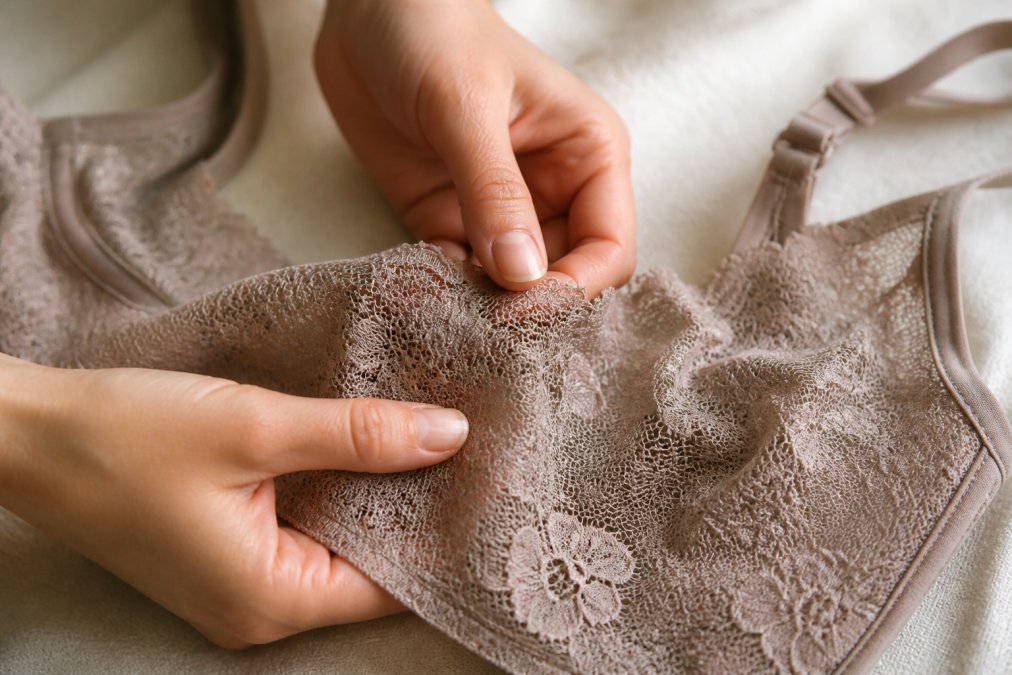
Construction Details: Enclosed Seams, Stretch Finishes, and Scalloped Edges
Enclosed seams and stretch finishes separate lingerie you forget you're wearing from lingerie you're counting the hours until you can remove.
Three construction details to check:
- Enclosed seams: Finished edges that sit flat against skin instead of rubbing
- Stretch finishes: Elastic that recovers instead of stretching out by midday
- Scalloped edges: Decorative trim that lies flat rather than curling or digging
The Best Lace Underwear for Sensitive Skin
The best lace underwear for sensitive skin uses skin-friendly fibers, wirefree construction where possible, and irritation-free finishes. But "sensitive skin" is not one problem, it is at least four, and each has a different fix.
The Four Irritation Triggers and How to Neutralize Each
1. Mechanical friction. The most common cause of lace itch, it comes from fiber diameter and weave tightness, not lace itself. Fine-denier yarns (lower numbers mean finer, softer filaments) bend easily against skin; coarse yarns in open, scratchy netting stay stiff and abrade. A tight, dense weave spreads contact pressure across more surface area, so soft floral lace feels calmer than wide-open geometric mesh of the same fiber.
2. Chemical residue. Residual dye, formaldehyde-based finishing agents, and optical brighteners can trigger contact dermatitis on warm, occluded skin. If a piece itches out of the bag but softens after two or three gentle washes, residue was likely the culprit, so wash new lace before the first wear.
3. Allergen contact. Two hidden offenders sit inside otherwise comfortable lingerie: latex in some elastics and nickel in metal hardware. If irritation shows up as a red, well-defined line exactly where an elastic or hook sits, suspect the material rather than the fit. Look for latex-free elastics and coated or plastic hardware.
4. Pressure and heat. Rigid underwire channels, tight bands, and non-breathable linings trap moisture and concentrate pressure. This overlaps most with fit, which is why the same lace can be fine in one size and unbearable in another.
Sensory-Friendly Lace: What to Look For
Sensory-friendly lace prioritizes softness over structure. The Deep-V Lace Bralette from TLovePlusSize uses a soft elastic underband instead of a wire, with lace through the cups, a good example of what to look for: lightweight layers, no rigid hardware, and a fit that does not press.

When you are testing lace against sensitive skin, check for these markers:
- Soft-touch lace with a fine, tight weave rather than open, scratchy netting
- Wirefree or covered underwire so no metal sits directly against skin
- Flat, enclosed seams along the band and cup edges
- Moisture-wicking blends that keep skin dry through the day
- Latex-free elastic if you react to standard stretch bands
- No tags at the band, printed labels beat sewn-in ones for anyone who reacts to scratch
A Practical Patch Test You Can Run in Two Minutes
Before committing to a full day of wear:
- Rub the lace against your inner wrist for 20 seconds. Fine, tight weaves glide; coarse netting drags.
- Press the band and cup edge against your ribcage for 30 seconds. Any sharp or stiff point will announce itself now, not at hour three.
- Check the hardware. If a hook, slider, or underwire tip touches skin directly, layer it or choose a different piece.
- Wear it for a short errand first. Reactive skin usually responds within the first hour of warmth and movement.
Comfortable Lingerie for Plus Size: Fit and Support That Works
Comfortable lingerie for plus size starts with proper cup sizing and a band that distributes weight instead of cutting in. A band that rolls or digs usually means the size is wrong, not that the style cannot work. But most fit guides skip a second variable: how lace behaves under load, which changes dramatically as cup size increases.
How Lace Elasticity Actually Behaves Across Cup Sizes
Lace is a ground mesh with a pattern stitched or knit into it, and its stretch comes from the yarns running through that ground. That structure produces three predictable behaviors:
- Smaller cups (A-C): Lace can carry most of the cup on its own. Stretch recovery is rarely tested, so almost any soft-touch lace feels comfortable.
- Mid cups (D-F): Lace begins to stretch under its own weight. A cup that is cut as a single lace panel will gradually relax and lose shape over a wear. Look for lace layered over a stable mesh or lined with a stretch tulle.
- Fuller cups (G and up): Lace alone cannot support the cup. It needs a seamed or molded structure underneath, a three- or four-part cup, a side sling, or an underwire, with lace as the outer layer. This is why the most comfortable fuller-cup lace bras are almost always seamed rather than seamless.
The takeaway: as cup size rises, lace should be the decoration over a support structure, not the structure itself. A bra that ignores this rule will feel fine in the fitting room and fail by mid-afternoon.
Band Construction: Where Plus-Size Comfort Is Won or Lost
Roughly 80 percent of a bra's support should come from the band, not the straps. On a fuller figure, that band holds more weight across a longer circumference, so construction matters more than width alone.
- A firm, wide band with multiple hook-and-eye columns distributes load better than a narrow, stretchy band.
- A band that rolls is usually too loose, not too tight, it has nowhere to anchor, so it migrates.
- A band that digs is usually too small in the cup, forcing the band to compensate for volume it cannot hold.
- Side seams and boning in the band help prevent roll on softer torsos, but any boning should be encased, never exposed.
The Goddess Lace Set holds up to an I cup with underwire structure and a structured band, with floral lace across the cups and matching brief. That combination of real support and delicate lace makes a piece wearable rather than decorative.
Size-Inclusive Fit Testing: How to Check Before You Buy
Size-inclusive fit testing means measuring yourself and checking the brand's size chart against your actual measurements, not the size you wear in other garments. Cup and band sizing varies between brands, and guessing costs you returns.
Run this check before ordering:
- Measure your underbust snugly, then add the band size your chart specifies
- Measure your fullest bust point and subtract underbust to find cup size
- Compare both numbers against the brand's own chart, not a generic one
- Check the return window in case your size shifts
- Confirm the brand lists a cup range, not just a band range, "up to an I cup" is a real spec; "plus size" is not
Fit Troubleshooting by Symptom
| Fit Issue | Likely Cause | What to Try |
|---|---|---|
| Band rolls down | Band too loose | Size down in the band |
| Cups cut in | Cup too small | Size up in the cup |
| Straps dig in | Support coming from straps | Tighten band, loosen straps |
| Lace itches | Rough fiber blend | Switch to soft-touch lace |
| Cup loses shape by afternoon | Lace carrying the cup alone | Choose a seamed or lined cup |
| Underwire pokes at the side | Cup too shallow | Size up in cup or try a deeper style |
Structured vs. Unstructured Lace: Which Support Level Is Right for You?
Structured lace uses underwire and seamed cups to hold and shape; unstructured lace relies on soft elastic and stretch for a lighter, wirefree fit. Neither is better. The right choice depends on your bust size and how you plan to wear the piece.
For fuller busts, structured styles like The Strappy Underwire combine lace cups with mesh paneling and underwire that holds to an I cup. The strapping detail is decorative, not structural, which is worth knowing before you buy.

For lighter support days, The Front-Close Lace Bralette buttons up the front with a halter neckline and no wires. It works under backless tops and low-back dresses where a hook-and-eye band would show.
How to Wash Delicate Lace Lingerie So It Lasts
Hand washing in cool water with a gentle detergent is the safest way to clean delicate lace lingerie and protect its elasticity. Hot water and tumble drying break down stretch fibers fastest.
If you machine wash, use a mesh lingerie bag on a delicate cycle with cold water. Skip the dryer entirely. Lay pieces flat to dry, reshaping cups by hand so they hold their form.
- Delicate wash only: Cool water, gentle detergent, no bleach
- Mesh bag: Protects scalloped edges and strapping from snags
- No dryer: Heat destroys elasticity in lace and elastic bands
- Lingerie rotation: Rotate several pieces so each one rests between wears
FTC guidance on textile care labeling explains what care instructions on garment labels are required to tell you, which helps you sort what can be machine washed from what genuinely needs hand washing.
Sustainability and Fabric Sourcing: What to Know About Your Lace
Sustainable lace sourcing means knowing where the fibers come from and whether the mill uses recycled or responsibly produced materials. Textile Exchange's fiber and materials work tracks how different fiber choices affect environmental impact across the supply chain.
Ask three questions about any lace piece: what the fiber is, whether it's recycled or virgin, and whether the brand publishes its sourcing. Brands that can answer those questions tend to also build garments that last longer, which is the most sustainable outcome of all.
Longevity Testing: How to Tell If Lace Will Hold Up
Lace that will last passes three quick tests: it recovers shape when stretched, seams stay flat after washing, and color holds through repeated gentle washes. Failing any one signals a short lifespan.
Try this before your return window closes:
- Stretch test: Gently pull the band and cups. Good lace snaps back; poor lace stays stretched.
- Seam test: Run a finger along the inside seams. Any roughness will worsen with wear.
- Wash test: Hand wash once and lay flat. If edges curl or color runs, return it.
Durable elasticity and enclosed seams separate lace that lasts a year from lace that lasts a month. Check both before you commit.
Frequently Asked Questions
How do you find comfortable lace lingerie that doesn't itch?
Look for soft-touch lace made from nylon and spandex blends, which feel smoother against the skin than stiff polyester styles. Check for enclosed seams and stretch finishes that prevent scratching. Brands like TLovePlusSize design lace with delicate elasticity and skin-friendly materials. Reading reviews from women with sensitive skin helps confirm real-world comfort before you buy.
What materials make lace lingerie more comfortable for daily wear?
Nylon and spandex blends create soft, stretchy lace that moves with your body. Cotton-lined gussets add breathability. Moisture-wicking finishes keep you dry. Avoid lace with high polyester content, which can feel stiff and trap heat. The best lace underwear for sensitive skin uses fabric composition that balances softness, durability, and airflow for all-day wearability.
Can you wear lace lingerie all day without discomfort?
Yes, if the fit and construction are right. Choose wirefree or underwire styles with supportive bands and seamless construction. Lace with stretch finishes and enclosed seams prevents irritation. For plus-size comfort, look for brands that offer size-inclusive fit testing and designs that accommodate natural curves. Many women wear lace bralettes and briefs from morning to night without adjusting.
How should lace lingerie fit to ensure maximum comfort?
The band should sit snug but not dig in, and the cups should contain your bust without gaping or spillage. Briefs should lie flat without rolling down. Look for adjustable straps, hook-and-eye closures, and stretch lace that follows your shape. If you're between sizes, size up for comfort. A well-fitted lace set feels barely-there while still providing support.
Lace lingerie that is actually comfortable exists, but it takes knowing what to look for: soft-touch fibers, enclosed seams, and support that matches your body and your day. TLovePlusSize builds pieces around exactly that balance, from the wirefree Deep-V Lace Bralette to the full-coverage Goddess Lace Set that holds up to an I cup. Explore the collection and find lace you'll actually want to wear past lunch.