


Table of Contents
- Why Lace Lingerie Performs Better Than Plain Fabric on Camera
- The Best Plus Size Lingerie for Boudoir: What to Look For
- Our Top Picks for Plus Size Lace Lingerie
- Tips for Plus Size Boudoir Preparation
- How to Style Lace Lingerie for Photoshoots
- Lace Durability and Fabric Quality in Larger Sizes
- Budget-Friendly vs. Investment Lace Pieces
- Frequently Asked Questions
Last Updated: September 28, 2026
Why Lace Lingerie Performs Better Than Plain Fabric on Camera
Lace lingerie is worth it for boudoir shoots because texture reads on camera in a way flat fabric cannot: satin or cotton photographs as one continuous tone, while lace breaks light into hundreds of small shadows.
- Texture under directional light. Raised floral or scalloped patterns create shadow and highlight.
- Contrast against skin. Lace edges create a defined line where the garment ends.
- Structure underneath. Without it, lace drapes and the shape disappears.
The Best Plus Size Lingerie for Boudoir: What to Look For
The best plus size lingerie for boudoir combines real underwire support, lace with visible pattern, and a band that stays put. Skip any one and the photos show it.
Underwire Structure and Cup Sizing
Underwire is not optional for a boudoir shoot above a D cup. A soft cup lets the bust sit lower and wider, reading as a less defined silhouette. A proper underwire lifts from below and separates, giving the photographer a clean line to light.
Scalloped Lace vs. Stretch Lace: Which Photographs Better
Scalloped lace photographs better for detail shots; stretch lace photographs better for full-body shots.
Our Top Picks for Plus Size Lace Lingerie
Every piece below is built for a fuller bust and a real photograph. Prices are as listed, and each one solves a different problem.
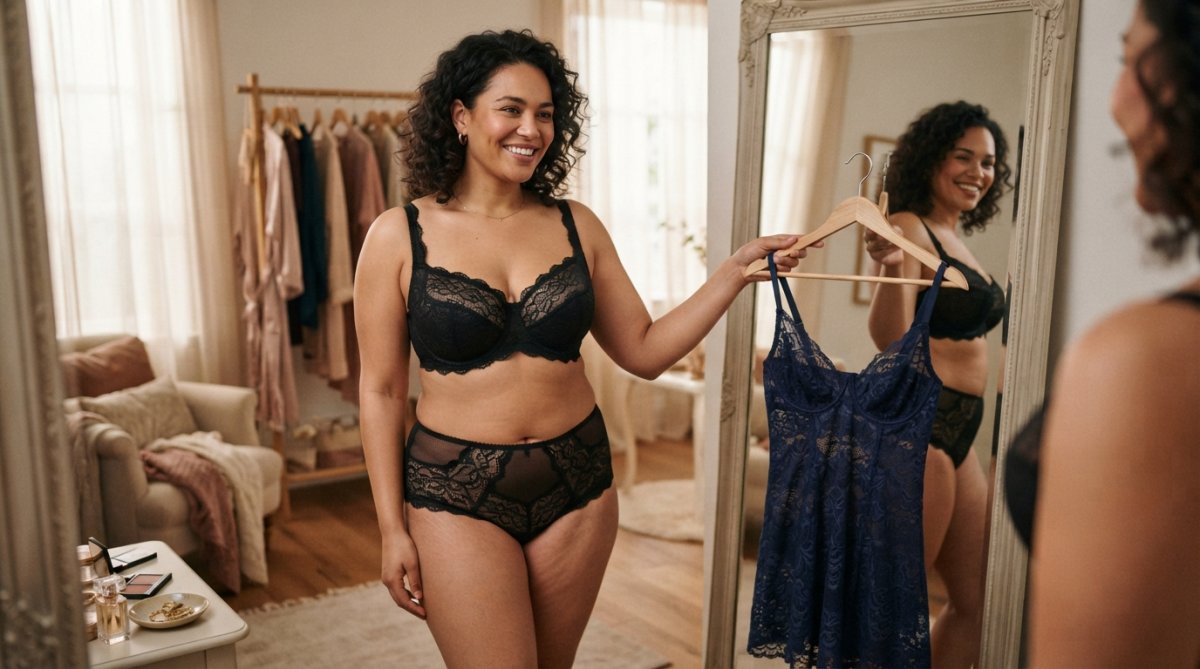
The Goddess Lace Set: Full Coverage, I-Cup Support
Full coverage without looking like shapewear is the hard part, and this set gets it right. Floral lace runs across the cups and matching brief in black, with underwire and a structured band doing the holding, and it runs to an I cup.
The Longline Lace Bustier: Built to Be Photographed
Longline pieces photograph well because more fabric means more lace means more texture in frame. This one zips up the front, holds its shape through a long session, and comes in tones from pure white to deep black, with light boning through the band.
The Strappy Lace Set: Detail at Every Focal Point
Strapping across the cups and around the waistline of the brief gives the camera multiple places to land, this is the piece for shots about the lingerie itself rather than the face. Full underwire handles a fuller bust; the strapping is decorative. At $53, it is the most expensive piece here, and it earns it on detail density.
Tips for Plus Size Boudoir Preparation
Preparation for a lace boudoir shoot is mostly about testing the lace before the camera does. Lace behaves differently on a larger body under studio conditions, and the failures are predictable.
Break In the Lace Before the Shoot
New lace has sizing and stiffness that relax after the first wear, and a band that feels snug in the dressing room may dig after twenty minutes under lights. Wear each piece for at least an hour at home while sitting, standing, and reaching overhead. Watch three things:
- Where the lace edge sits against skin. If it leaves a red mark after an hour, it will leave a visible mark in photos.
- Whether the stretch lace recovers. Pull the lace gently at the hip or cup edge and release. It should snap back flat. If it stays stretched, it will bag in photos.
- Whether the underwire stays in place. Raise your arms, bend forward, twist. The wire should not migrate.
Test the Lace Under Studio-Equivalent Light
Bathroom lighting is warm and diffuse; studio lighting is directional and often cooler. The same lace piece can look rich in a bathroom mirror and flat under a softbox.
Prepare Your Skin for Lace Contact
Lace edges rub. On a larger body, the contact points are more numerous and the friction is greater. A few days before the shoot:
- Moisturize the areas where lace edges sit, under the bust, along the band line, at the hip. Dry skin catches on lace and creates redness.
- Skip exfoliants and retinoids for 48 hours before. These thin the skin and make lace irritation more likely.
- Do not shave or wax the day of the shoot. Freshly exfoliated skin reacts to lace faster. Give it at least 24 hours.
- Bring a fragrance-free lotion to the shoot. If a lace edge starts to irritate, a small amount of lotion under the edge reduces friction without showing on camera.
Bring More Than One Lace Piece, and One Non-Lace Backup
Lighting, posing, and energy level all change what works once you are in the room. A lace piece that looked perfect at home may not read under the photographer's setup. Bring:
- One structured lace piece (underwire, boning, or firm band) for the main shots.
- One stretch lace piece for movement and full-body frames.
- One solid fabric piece as a backup if the lace is not cooperating.
Manage the Logistics That Affect Your Face
The camera reads tension in the jaw, shoulders, and around the eyes, most of it from being cold, hungry, or rushed.
- Eat normally that morning. Low blood sugar shows in the eyes before it shows anywhere else.
- Book late morning if you can. Jaw and shoulder tension tends to release by mid-morning for most people.
- Bring a robe and slippers. Downtime between setups is real, and staying warm keeps the body relaxed.
- Tell the photographer your concerns up front. A good one will adjust angles and lighting rather than talk you out of them.
Know What to Do If the Lace Fails
Even a well-chosen lace piece can fail on the day, a strap snaps, a wire pokes through, a seam splits. Bring a small repair kit: a safety pin, a needle and matching thread, and a spare bra strap. Most lace failures are fixable in under two minutes.
How to Style Lace Lingerie for Photoshoots
Styling lace for photos is not the same as styling lace for a mirror. The camera sees pattern density, edge geometry, and how light rakes across a raised surface, so the decisions that matter most are tied to lace construction, not color coordination.
Match the Lace Pattern to Your Silhouette
Not every lace pattern flatters every shape, and the difference is visible in photos even when it is invisible in person.
- Floral and organic patterns (rose, vine, leaf) break up a large surface area and soften the visual line of the body. They work well on pear and apple silhouettes where you want the eye to move rather than stop.
- Geometric and linear patterns (diamond, chevron, grid) create strong directional lines. On an hourglass or inverted-triangle shape, they emphasize the waist-to-hip ratio. On a rounder midsection, they can create a moiré effect in high-resolution photos.
- Scalloped edges act as a frame. At the neckline, they draw the eye up; at the hip, down. Decide which direction you want the viewer's eye to travel before you choose the piece.
- Allover dense lace with no negative space reads as a solid tone from more than six feet away. For texture visible in full-body shots, look for lace with visible gaps between motifs.
Control How the Lace Catches Light
Studio lighting is directional. A softbox at 45 degrees grazes across lace and throws a shadow into every motif; a ring light or on-camera flash flattens the lace and erases the texture. This is the single biggest variable in whether your lace reads on camera. What to tell your photographer:
- Ask for side or raking light on lace detail shots. The shadow is the point.
- Avoid flat frontal lighting for full-body lace frames. It turns textured lace into a solid block of color.
- Use a reflector below the chin for close-ups. It fills the shadow under the lace edge without killing the texture above it.
- If the lace is black, ask for a rim light. Black lace on skin loses its edge without a highlight behind it.
Build Contrast Deliberately
Lace needs something to read against, skin, fabric, or a wall.
- Black lace against pale sheets gives maximum edge definition. This is the safest combination for a first shoot.
- White or ivory lace against a dark wall gives the same effect in reverse, but it also shows every shadow on the body. It is less forgiving.
- Nude or blush lace against skin is the hardest to photograph because there is no contrast line. It works only with strong side lighting and a defined silhouette.
- Layering a sheer robe over a structured lace piece adds movement without hiding the lace. The robe should be lighter in tone than the lace or it will swallow it.
Use the Waistline as a Compositional Anchor
High-waisted lace briefs create a horizontal line across the frame, balancing the vertical of the body and giving the photographer a place to crop. Low-rise briefs extend the torso and push visual weight downward. Neither is wrong, but they produce different photos. For lace specifically, a high-waisted brief with a scalloped top edge gives you two lines to work with: the waistband and the lace edge.
Keep the Rest of the Frame Quiet
Lace is already a pattern. Adding a necklace, bracelet, and hair accessory gives the camera four competing textures. The rule most boudoir photographers follow is one lace focal point per frame: if the lace is on the bust, keep the hips simple; if it is on the brief, keep the top minimal.
Lace Durability and Fabric Quality in Larger Sizes
Lace on a larger body takes more load than lace on a smaller one, and that is where cheap pieces fail. The pattern is not the problem; the base is.
- Stretch recovery. Pull the lace gently and let go. It should snap back flat.
- Seam finishing. Raw edges fray. Bound or folded edges last.
- Underwire casing. The channel should be wide enough that the wire cannot poke through.
- Band width. A wider band distributes weight and holds position.
Budget-Friendly vs. Investment Lace Pieces
You do not need to spend a lot to look good on camera. You need to spend in the right place.
| Piece | Price | Support Level | Best For |
|---|---|---|---|
| The Leopard Underwire | $33 | Medium to firm | Statement detail, I-cup hold |
| The Front-Close Lace Bralette | $33 | Light | Backless and low-back outfits |
| The Deep-V Lace Bralette | $33 | Light to medium | Lounge and soft, natural shots |
| The Lace Set | $39 | Medium | A coordinated set at a low entry price |
| The Goddess Lace Set | $40 | Medium to firm | Full coverage, I-cup support |
| The Longline Lace Bustier | $40 | Medium to firm | Long sessions, bridal tones |
| The Sheer Lace Underwire | $40 | Medium to firm | Natural shape, no padding |
| The Strappy Underwire | $40 | Medium to firm | Decorative detail with real hold |
| The Lace Corset Top | $43 | Firm | Worn out, or as the statement piece |
| The Strappy Lace Set | $53 | Medium to firm | Maximum detail, lingerie as the moment |
Frequently Asked Questions
Does lace lingerie look good on plus size bodies?
Yes. Lace adds visual texture and dimension that photographs better than smooth fabric, especially under studio lighting. The key is choosing the right lace type: scalloped lace edges create a flattering frame around curves, while stretch lace moves with the body instead of digging in. Look for pieces with supportive underwire and a structured band, like a full-coverage lace set that holds up to an I cup, so the lace enhances your shape rather than flattening it.

What should I wear for a plus size boudoir photoshoot?
Start with a well-fitted lace set that has underwire support and a band that stays put. A full-coverage lace set or a longline bustier works well because the structure holds its shape through a long shoot. Bring two to three options so you can switch looks: a coordinated lace set for classic shots, a corset top for a structured silhouette, and a bralette for softer, more relaxed poses. Fit matters more than style, so test each piece before the shoot day.
How do I choose lingerie that makes me feel confident for boudoir?
Confidence starts with fit. A piece that stays in place and supports your bust without digging into your sides lets you focus on posing instead of adjusting. Try the lingerie on at home, move around, sit, and raise your arms to confirm the band and straps hold. Choose a lace style you actually like looking at, whether that is floral, strappy, or sheer. When the garment feels like it belongs on your body, that comfort shows in the photos.
How can I prepare for a boudoir shoot if I am plus size?
Book a fitting or try your lingerie on at least a week before the shoot so you have time to exchange anything that does not fit. Practice a few poses in front of a mirror, focusing on angles that feel natural: a hand on the hip, a slight turn at the waist, a seated pose with one leg extended. Stay hydrated, get rest the night before, and bring a robe or cover-up for breaks. Communicate with your photographer about the angles and lighting you prefer.
Does lace lingerie photograph well in boudoir settings?
Lace is one of the best fabrics for boudoir photography because the open weave catches light and creates shadow, adding depth that solid fabric cannot. Scalloped edges and floral patterns give the camera something to focus on beyond the silhouette. In low-light studio settings, lace with a bit of sheen or contrast against skin tones reads clearly. A structured lace set with underwire keeps the shape defined, so the lace detail stays visible rather than blending into the background.
The hard part of a boudoir shoot is not the camera. It is walking in wearing something that fits, holds, and looks like you chose it on purpose. That is the whole job of a lace piece with real structure behind it.
TLovePlusSize builds lingerie and shapewear for exactly that moment, with underwire pieces that run to an I cup, lace sets with matching briefs, and longline styles that hold their shape through a full session. Explore the collection and find the piece you want to be photographed in.