


Table of Contents
- Why Lace Shapewear Sometimes Shows (and When It Doesn't)
- How to Stop Shapewear Rolling Down Under Your Outfit
- Seamless Shapewear for Tight Dresses: What Actually Works
- Shapewear Sizing Guide: Getting the Right Fit for a Smooth Silhouette
- Color Matching and Fabric Friction: The Two Details Most Guides Skip
- Lace Patterns vs. Smooth Shapewear: Which Texture Disappears Better?
- Conclusion
- Frequently Asked Questions
Last Updated: September 15, 2026
Why Lace Shapewear Sometimes Shows (and When It Doesn't)
Does lace shapewear show under clothes? The short answer: sometimes, and the reason is almost never the lace itself. It is the combination of fabric weight, color, and how the lace texture interacts with the garment on top. This guide from TLovePlusSize breaks down exactly when lace shapewear stays invisible and when it does not.
Here is the core principle most shoppers never hear. Lace shapewear is any foundation garment that uses lace as a decorative or structural element, rather than a completely smooth knit surface. That texture is what creates the risk. A smooth finish glides under fabric; a raised lace pattern can telegraph through thin or clingy material.
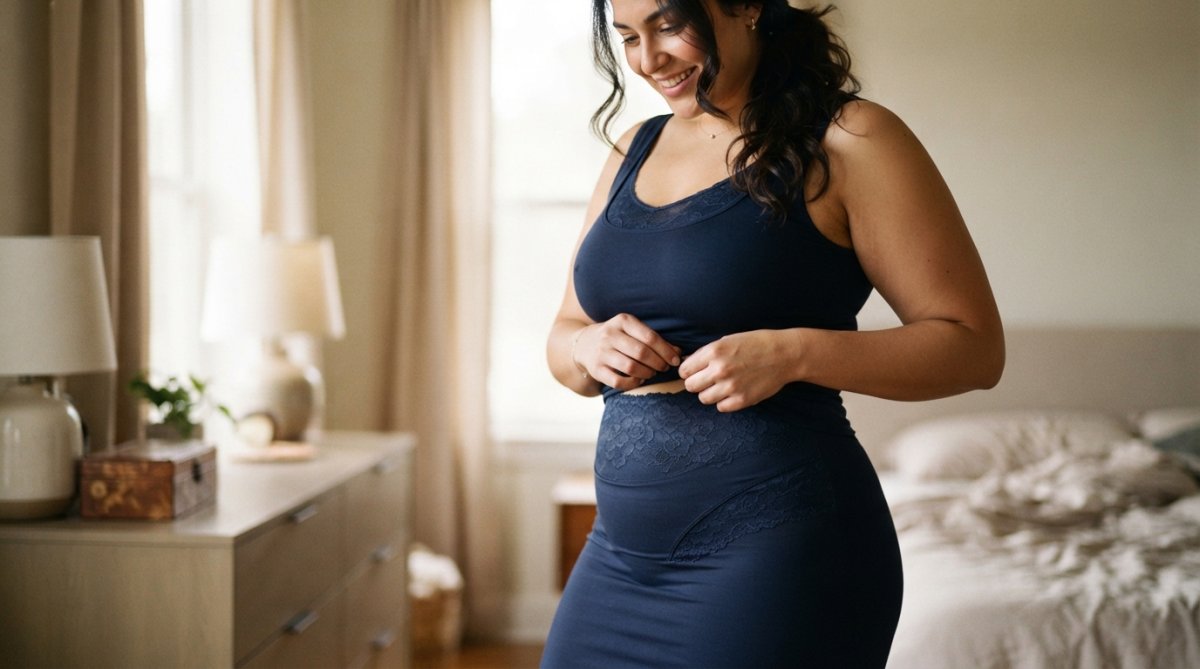
Three factors decide whether lace shapewear shows under clothes:
- Fabric weight of the outer garment. Lightweight jersey and thin silk reveal texture. Structured wovens, ponte, and lined fabrics hide it.
- Color contrast. Dark shapewear under light clothing creates a visible shadow, even when the texture is smooth (marthastewart.com).
- Lace placement. Lace at the edges, waistband, or hem sits closer to the garment surface than lace on flat panels.
A common mistake is blaming the lace when the real problem is a color mismatch or a fabric that was never going to hide any foundation garment, lace or not.
How to Stop Shapewear Rolling Down Under Your Outfit
The fix for rolling starts before you put the shaper on. Most rolling happens because the garment is sized too small at the waist or the band has no grip.
To stop shapewear rolling down:
- Check the waistband construction. Silicone no-roll bands grip the skin and stay put. Plain elastic bands slide.
- Size up, not down. A shaper that digs in will roll. One that fits smoothly stays.
- Position the band at your natural waist, not above it, so it sits in the narrowest part of your torso.
- Smooth the shaper upward as you dress, so it lies flat against the skin with no folds.
- Avoid lotion on the band area on the day you wear it. Moisturizer reduces grip (9 ways to keep your clothes looking glam!).
Fabric friction matters here too. A slippery outer fabric over a slippery shaper gives the band nothing to hold against, which is why the same shaper behaves differently under two different dresses.
Seamless Shapewear for Tight Dresses: What Actually Works
Seamless shapewear for tight dresses works when it uses laser-cut or bonded seams instead of stitched ones. Stitched seams create ridges that press into the dress fabric. Bonded seams lie flat.
The features that disappear best under a tight dress:
- Laser-cut edges that need no hem, so there is no line to show through
- Bonded seams that fuse fabric layers instead of stitching them
- Medium compression rather than firm, because firm compression creates tension lines in the outer fabric (pubmed.ncbi.nlm.nih.gov)
TLovePlusSize's The Power Bodysuit Shaper is built for exactly this. It runs in three tones so you can match it to your outfit instead of fighting it, and it delivers a medium hold that smooths without creating tension ridges. For dresses that end above the knee, The Brief Shaper Bodysuit stops at the brief, so there is no longer shaper edge to betray the hemline.


Shapewear Sizing Guide: Getting the Right Fit for a Smooth Silhouette
The right size is the one that lies flat with no digging and no gaping. Most people wear shapewear one size too small, which is the single biggest cause of rolling, bunching, and visible lines. But with lace shapewear, sizing has a second job: it controls how much the lace trim presses into the outer garment.
Here is the mechanism. Compression garments work by distributing tension across the panel. When a shaper is too small, that tension concentrates at the edges, the waistband, the leg opening, the lace trim, and those edges push outward against whatever you wear on top. A correctly sized shaper spreads the same hold across a larger surface, so the lace edge sits flush instead of pressing a ridge into the dress.
Use this quick reference:
| Fit Problem | What It Causes | The Fix |
|---|---|---|
| Band digs into sides | Rolling and discomfort | Size up at the waist |
| Fabric gapes at the hip | Bunching under dress | Step down one size |
| Shaper rides up at the leg | Visible hem line | Choose a longer leg length |
| Compression feels tight to breathe | Tension lines in outer fabric | Switch to medium hold |
| Lace trim leaves a faint ridge | Edge tension from undersizing | Size up one step, or switch to a flat-lace edge |
A shaper should feel snug, never restrictive. If you can pinch more than an inch of loose fabric at the hip, it is too large. If the band leaves a red mark after an hour, it is too small.
Sizing for lace-trimmed pieces specifically. Lace has less stretch recovery than a knit panel, so a lace waistband or lace leg trim will not forgive a size that is slightly off the way a plain elastic band will. Two practical rules:
- If you are between sizes and the shaper has lace trim at the edge, take the larger size. The lace edge is the part that shows.
- If the shaper has lace only on flat body panels (not at the edges), you can size normally, the trim is not under tension against the outer garment.
How to measure once, correctly. Measure your natural waist (the narrowest point, usually just above the navel) and your hip at the fullest point, standing relaxed, not sucking in. Compare both against the brand's size chart and size to the larger of the two measurements. Sizing to the smaller measurement is the most common cause of the 'digs in at the sides' problem in the table above.
Color Matching and Fabric Friction: The Two Details Most Guides Skip
Two details decide invisibility more than any other factor, and most guides ignore both.
Color matching for sheer lace. Under a sheer or semi-sheer garment, the shapewear color becomes part of the outfit. Skin-tone and coffee tones sit closest to most complexions and disappear under light fabric. Black is the safest choice under dark clothing. A bright or mismatched tone will show through sheer lace even when the texture does not.
Fabric friction and static. When two synthetic fabrics rub together, static builds and the outer garment clings to the shaper, highlighting every contour. A slip or liner between the two layers breaks the friction. A light spritz of anti-static spray on the inside of the dress helps on dry days.
Lace Patterns vs. Smooth Shapewear: Which Texture Disappears Better?
Smooth shapewear disappears better under thin fabric. Lace shapewear disappears better under structured fabric, where the extra surface area of the lace actually helps the outer garment sit away from the body. That is the baseline rule. But the details most guides skip are the ones that decide whether lace shows in practice: pattern scale, color behavior under sheer lace, and static.
The rule of thumb:
- Thin, clingy fabric (jersey, silk, lightweight knit): choose smooth, seamless construction.
- Structured fabric (ponte, lined dresses, wool blends): lace is safe and adds no visible line.
- Sheer lace outerwear: smooth shapewear underneath, matched to your skin tone.
Pattern scale matters more than 'lace vs. smooth.' A fine, flat lace with a tight repeat reads as texture, not as a shape, under fabric. A large, open, heavily corded lace reads as a raised pattern, and that pattern is what telegraphs through. If you want lace for everyday wear, look for flat-pattern lace at the edges rather than thick three-dimensional lace across the front panel. The same principle applies to the outer garment: an intricate lace dress with a busy pattern breaks up any underlying texture, while a sparse lace with large open motifs leaves smooth gaps where shapewear edges can show.
Color matching for sheer lace, the detail most guides skip. Under a sheer or semi-sheer garment, the shapewear color becomes part of the outfit, and the wrong tone creates a 'ghosting' effect: a faint shadow of the shaper visible through the lace even when the texture does not show.
Conclusion
Frequently Asked Questions
Does lace shapewear show under tight dresses?
It depends on the fabric weight and color match. Lace texture can create bumps under thin, clingy fabrics, but under medium to heavy fabrics with proper color matching, lace shapewear stays invisible. Look for styles with laser-cut edges and bonded seams, which eliminate the ridges that traditional sewn seams create. A nude or skin-tone lace piece that matches your skin (not the dress) is your best bet for a smooth finish.
Is lace shapewear less effective than smooth fabric?
Not necessarily. Effectiveness comes from the garment's construction, compression level, and fit, not the surface texture. Lace panels are often added at the edges or back for breathability and stretch, while the front and sides use smooth compression fabric. The key is choosing a piece where the lace sits in low-friction zones and the smooth panels cover the areas you want to smooth.
How do I prevent shapewear lines from showing?
Start with the right size: too-small shapewear creates bulges at the edges, and too-large shapewear bunches. Choose seamless or laser-cut construction, match the color to your skin tone, and check that the leg openings and waistband lie flat. For tight dresses, a high-waist thigh shaper with a silicone no-roll band holds everything in place.
What is the best fabric for invisible shapewear?
Nylon and spandex blends with a high spandex content (around 20-30%) offer the best stretch and recovery. Look for fabric weight between 180-220 GSM for opacity without bulk. Laser-cut edges and bonded seams are more important than the fabric name itself. Avoid cotton-heavy blends for invisible wear because they add bulk and don't smooth as effectively. Breathable mesh panels help with comfort without adding visible texture.