


Table of Contents
- How to Measure for Plus Size Lingerie
- Best Plus Size Lingerie Brands and What to Look For
- Most Flattering Plus Size Lingerie Styles for Curves
- Comfortable Plus Size Shapewear That Stays Put
- Fabric and Support: What Makes Plus Size Lingerie Comfortable
- Everyday vs. Special Occasion: Styling Your Plus Size Lingerie
- How Lingerie Affects Body Confidence
- Frequently Asked Questions
Last Updated: October 1, 2026
How to Measure for Plus Size Lingerie
Finding the most flattering plus size lingerie for curves starts with two numbers most women measure wrong: band size and cup size. A well-fitted bra sits flat against your ribcage, with the band doing roughly 80% of the support work and the straps handling the rest. When the band is too loose, the straps take over, and that's where digging, slipping, and shoulder pain begin.
- Band size: Wrap a soft tape measure snugly around your ribcage, directly under your bust. Round to the nearest even number. If you land on an odd number, round down for a snugger fit or up for more breathing room.
- Cup size: Measure around the fullest part of your bust, keeping the tape level. Subtract your band size from this number. A 1-inch difference is an A cup, 2 inches is a B, and so on. Many full-figure women land between a DDD and an I cup, which is exactly the range where structured underwire matters most.
- Underbust check: If your current bra rides up in the back, your band is too large. If it leaves red marks that last more than an hour, it's too tight.
Best Plus Size Lingerie Brands and What to Look For
The best plus size lingerie brands share three traits: real cup-size ranges, structured support, and breathable fabric. Skip brands that only scale up a straight-size pattern without rebuilding the band, that's why so many "plus-friendly" pieces still cut into your sides.
- Does the bra go up to at least an H or I cup with underwire?
- Is the band constructed separately from the cups, or just one elastic strip?
- Are the straps adjustable, and are they wide enough not to dig?
- Does the brand list fabric content and stretch percentage?
- Are there real customer photos from women in your size range?
The Fit Mechanics That Separate a Real Plus-Size Brand From a Scaled-Up One
A brand that understands curves rebuilds four things when grading up a pattern, all four are visible without trying the piece on:
- Band-to-cup ratio. In a properly graded bra, the band grows in width and the cups grow in depth and projection, not just circumference. If the cups look shallow and wide relative to the band, the brand stretched a B-cup pattern sideways.
- Underwire gauge and shape. Full-bust underwires need a heavier gauge wire and a wider, taller arc that wraps the ribcage instead of pressing into the sternum. A thin wire that flexes easily under finger pressure will bow and dig by mid-afternoon.
- Strap width and attachment point. Straps on a full-bust bra should be at least 3/4 inch wide and set slightly inward at the back so they don't slide off sloped shoulders. Narrow, widely set straps are the tell of a straight-size pattern.
- Band hook count. Three or four columns of hooks on a wide band distribute tension better than two. A two-hook closure on a 42 band concentrates pull at two points and stretches out faster.
Fabric Science: What to Read on the Label
Fabric content tells you more about how a piece will wear than any product photo. Label-reading rules that hold up across brands:
- Elastane percentage. Look for 10-15% elastane (sometimes listed as spandex) in the band and cup fabric. Below 8%, the piece loses recovery and sags by mid-afternoon; above 20%, the fabric feels rubbery and traps heat.
- Nylon vs. polyester. Nylon blends feel softer and wick moisture better against skin; polyester holds color and shape longer but breathes less. For all-day wear, a nylon-dominant blend with elastane is usually the more comfortable choice.
- Lace backing. Soft-tipped or backed lace (often called "stretch lace" or "soft lace") has a smooth underside that reduces chafing at the band and cup edge. Unbacked rigid lace looks delicate but scratches.
- Mesh weight. A finer mesh (measured in denier) drapes and breathes better; a heavier mesh holds shape but can feel stiff. For chemises and babydolls, finer mesh skims curves instead of clinging.
A Note on Sizing Consistency
Even good brands vary one to two sizes between styles, so treat the size chart as a starting point. Order your measured size first, then adjust based on how the band sits. Between band sizes, size down in the band and up in the cup, the band does most of the support work.
Most Flattering Plus Size Lingerie Styles for Curves
The most flattering plus size lingerie for curves follows your natural silhouette instead of fighting it. For an hourglass or pear shape, a plunge bra with a high-waisted brief balances the hip-to-waist ratio. For an apple shape, a longline bustier defines the waist without squeezing the midsection. For a full bust, underwire is non-negotiable.
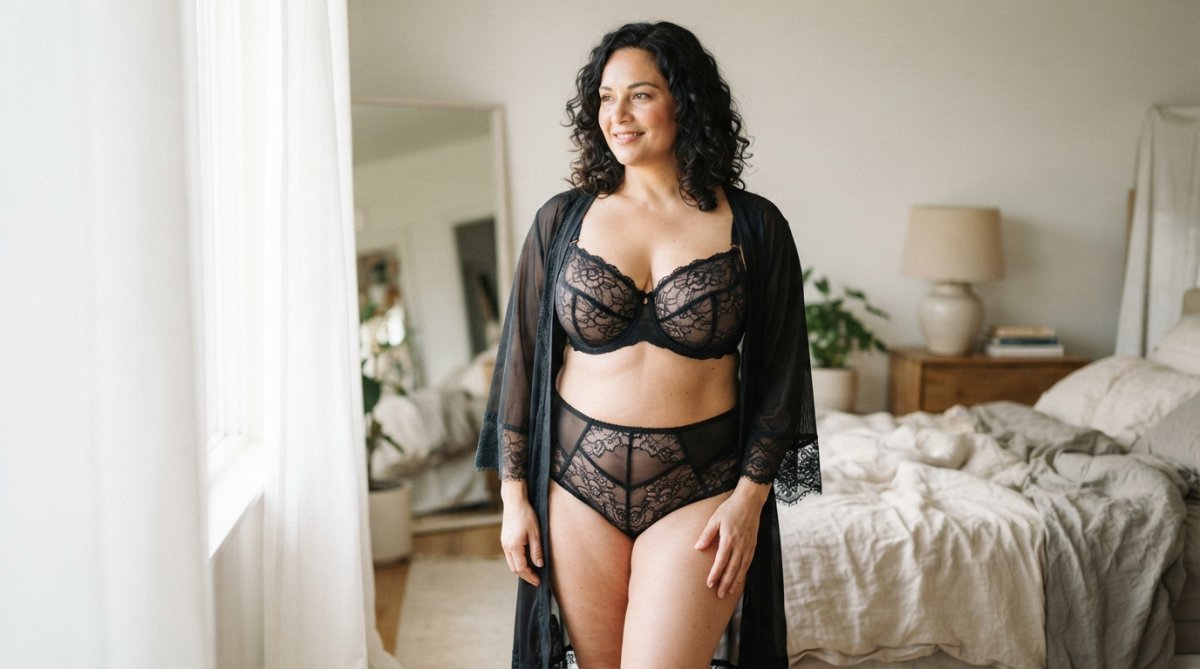
Here's how the main styles map to body types:
| Style | Best For | Support Level | Occasion |
|---|---|---|---|
| Plunge bra | Full bust, low necklines | Medium-firm | Date night |
| Babydoll | Apple shape, soft coverage | Light-medium | Romantic evenings |
| Chemise | Pear shape, fluid drape | Light | Everyday to evening |
| High-waisted brief | Hip and tummy smoothing | Medium | Daily wear |
| Longline bustier | Waist definition | Medium-firm | Bridal, special events |
Comfortable Plus Size Shapewear That Stays Put
Comfortable plus size shapewear that stays put comes down to one feature: a silicone or grip-lined waistband that anchors to your skin. Roll-down happens when the band is smooth elastic with nothing to hold it. If your shapewear rolls by noon, the band is the culprit, not your body.
Look for these construction details:
- Grip-lined hems at the waist and thighs to stop riding and rolling
- Bonded seams instead of bulky stitching that shows under fitted clothing
- Four-way stretch fabric that moves with you when you sit, stand, and bend
- A crotch closure if you want bathroom breaks to be quick and hassle-free
Fabric and Support: What Makes Plus Size Lingerie Comfortable
Breathability separates lingerie you wear once from lingerie you reach for weekly. Mesh and lace allow airflow, which matters more for fuller figures because skin-on-skin contact traps heat and moisture. Satin looks luxurious but holds warmth, so reserve it for cooler evenings or shorter wear.
The Breathability Gap Nobody Talks About
Most plus-size lingerie guides stop at "choose breathable fabrics" without explaining why fuller figures need more airflow. Where skin touches skin, under the bust, along the inner thigh, at the waistband, moisture has nowhere to evaporate. Trapped moisture softens the skin barrier, and friction against a seam or elastic edge causes chafing. That's why lace trim that feels fine on a smaller frame can irritate a fuller one.
Three fabric choices reduce that risk:
- Moisture-wicking blends. Look for nylon or bamboo-viscose blends with elastane. These pull moisture away from skin instead of holding it against the body. Cotton breathes well but loses shape; it works best in gussets and linings, not in support panels.
- Open-weave mesh and stretch lace. The gaps in the weave let air move. A backed stretch lace gives you the look of lace with a smooth underside that won't scratch.
- Bamboo and modal blends. Softer than polyester, naturally moisture-absorbing, and less likely to trigger sensitivity. They're a strong choice for chemises and sleep pieces worn against bare skin for hours.
Stretch Percentage and Recovery
Stretch percentage is the number nobody talks about. A fabric with 10-15% elastane recovers its shape after you move; a lower percentage sags by mid-afternoon. Recovery matters most at the band, gusset, and waistband, the three places that stretch every time you sit, stand, or bend. When fabric loses recovery, the band rides up, the gusset twists, and the waistband rolls.
Skin Sensitivity: What to Avoid
For sensitive skin, choose soft-tipped lace over stiff, scratchy trim, chafing at the band and cup edges is the most common comfort complaint. Two more triggers:
- Rigid, unbacked lace at the underbust and cup edge. The scratchy underside rubs against skin with every breath.
- Latex and rubber-based elastics in waistbands and straps. Some people react to the rubber itself, not the fabric. If a piece leaves a red, itchy line that lasts hours, the elastic is the likely culprit, not the size.
How Support Structures Distribute Weight
Full-coverage cups with a structured underwire distribute weight across your ribcage instead of concentrating it on your shoulders, the mechanical difference between a bra you tolerate and one that supports you. The band carries roughly 80% of the weight; the straps carry the rest. When the band is wide, firm, and hook-counted properly, the straps only hold the cups in place, which is why a well-fitted full-bust bra can have thin, decorative straps without digging.
Everyday vs. Special Occasion: Styling Your Plus Size Lingerie
Everyday plus size lingerie should prioritize seamless, breathable comfort under work clothes. Special occasion pieces can lean into lace, strapping, and drama because they're worn for hours, not all day. Own both categories instead of forcing one piece to do everything.
How Lingerie Affects Body Confidence
Lingerie shapes how you feel before anyone else sees it. When a piece fits your proportions properly, you stop adjusting, tugging, and thinking about your body, and that mental bandwidth goes somewhere better. Ill-fitting lingerie does the reverse, keeping you aware of every roll and dig all day.
Frequently Asked Questions
What lingerie styles are best for plus size bodies?
The most flattering styles depend on your body shape, but full-coverage lace sets, plunge bras, and high-waisted panties are consistently supportive. Look for underwire bras with structured bands and adjustable straps to lift and shape. Babydolls and chemises work well for a flowy, sensual look, while bodysuits offer a smooth silhouette. Prioritize pieces with breathable fabrics like mesh and stretch lace for comfort. TLovePlusSize's Goddess Lace Set, for example, supports up to an I cup with underwire and floral lace, making it a strong choice for curves.
How do I choose lingerie that flatters my curves?
Start by identifying your body shape, apple, pear, or hourglass, and choose styles that highlight your best features. For apple shapes, empire waists and babydolls draw the eye upward. Pear shapes benefit from high-waisted panties and balconette bras to balance proportions. Hourglass figures look great in plunge bras and fitted chemises. Always measure your band and cup size before buying; a proper fit prevents digging and rolling. Look for supportive elements like underwire and wide straps, and don't shy away from lace or strappy details that add visual interest.
What features should I look for in plus size lingerie for support?
Support comes from structure: underwire cups, a firm band, and adjustable straps are essential. A hook-and-eye closure with multiple settings lets you adjust for comfort. For shapewear, look for high-waisted designs with silicone grips to prevent rolling. Breathable fabrics like mesh and cotton blends keep you cool. TLovePlusSize's Strappy Underwire bra goes up to an I cup and combines lace with mesh for both support and style. Avoid pieces with flimsy elastic or single-layer fabrics that stretch out quickly.
How can I feel more confident in plus size lingerie?
Confidence starts with a proper fit, lingerie that digs, rolls, or gaps will distract you all day. Measure yourself accurately and choose styles that celebrate your shape rather than hide it. Lace, satin, and strappy details can make you feel sensual and put-together. Remember that comfort is key: if you're tugging at your shapewear, you won't feel confident. Try pieces from brands that use real plus-size models and offer size-inclusive ranges. TLovePlusSize designs with your curves in mind, so you can focus on feeling unstoppable.
Finding lingerie that genuinely flatters your curves shouldn't mean settling for pieces that dig, roll, or give up by midday. TLovePlusSize designs every set around structured underwire, grip-anchored bands, and breathable lace so support and elegance stop competing. Explore the collection to find your fit, from everyday essentials to lace-detailed statement pieces built to move with your confidence. Get started with TLovePlusSize and discover lingerie that finally fits the way it should.